Summary
-
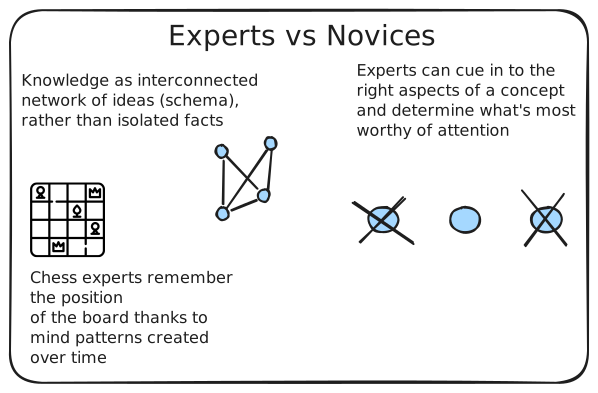
Experts hold more information than novices but what really makes the difference is how they organize their knowledge: Information as a series of interrelated concepts, called
schema, rather than isolated facts. -
When dealing with a new concepts, experts are able to easily determine what’s most worthy of attention. This is a huge advantage because they don’t expend unnecessary cognitive energy (as explained in the mind model, the attention that the working memory can provide is limited, it’s important to plan a careful allocation of attention)
The definition of schema, and the benefits of reducing the cognitive costs when dealing with a problem is not different, in my opinion, from how mental models have been defined by Charlie Munger (Found it on Shane Parrish’s Mental Models, Volume I):
latticework of mental models are chuncks of knowledge from different disciplines than can be simplified and applied to better understand the world. They help identify what information is relevant in any given situation, and the most reasonable parameters to work in.
How can Experts help Novices?
Experts hold very complex and abstract schemas which are not always easy to decode into something understandable to novices.
Experts can use Concrete examples when conveying new ideas to novices: examples help simplifying the complexity of their schema and hold powerful properties such as understanding and durable learning (and, I would add, since experts do not disperse cognitive costs while dealing with problems or new concepts, they know how to convey a new idea with the essential information, making the examples even more effective)
Appendix
Perception in chess
Credits, references and further reading
- Jim Heal & Rebekah Berlin, Mental Models, How understanding the mind can transform the way you work and learn, John Catt Educational, 2025 (9781398369689)
- Chess board icon made by Freepik from flaticon.com
- Chase, W.G., & Simon, H. A., Perception in chess, Cognitive Psychology, 55-81, 1973